Real-Time vs. Async Collaboration for Content: When to Use Each Approach
Learn when to use real-time vs async collaboration in content teams. Discover how to balance speed, focus, and better decision-making with the right workflow setup.

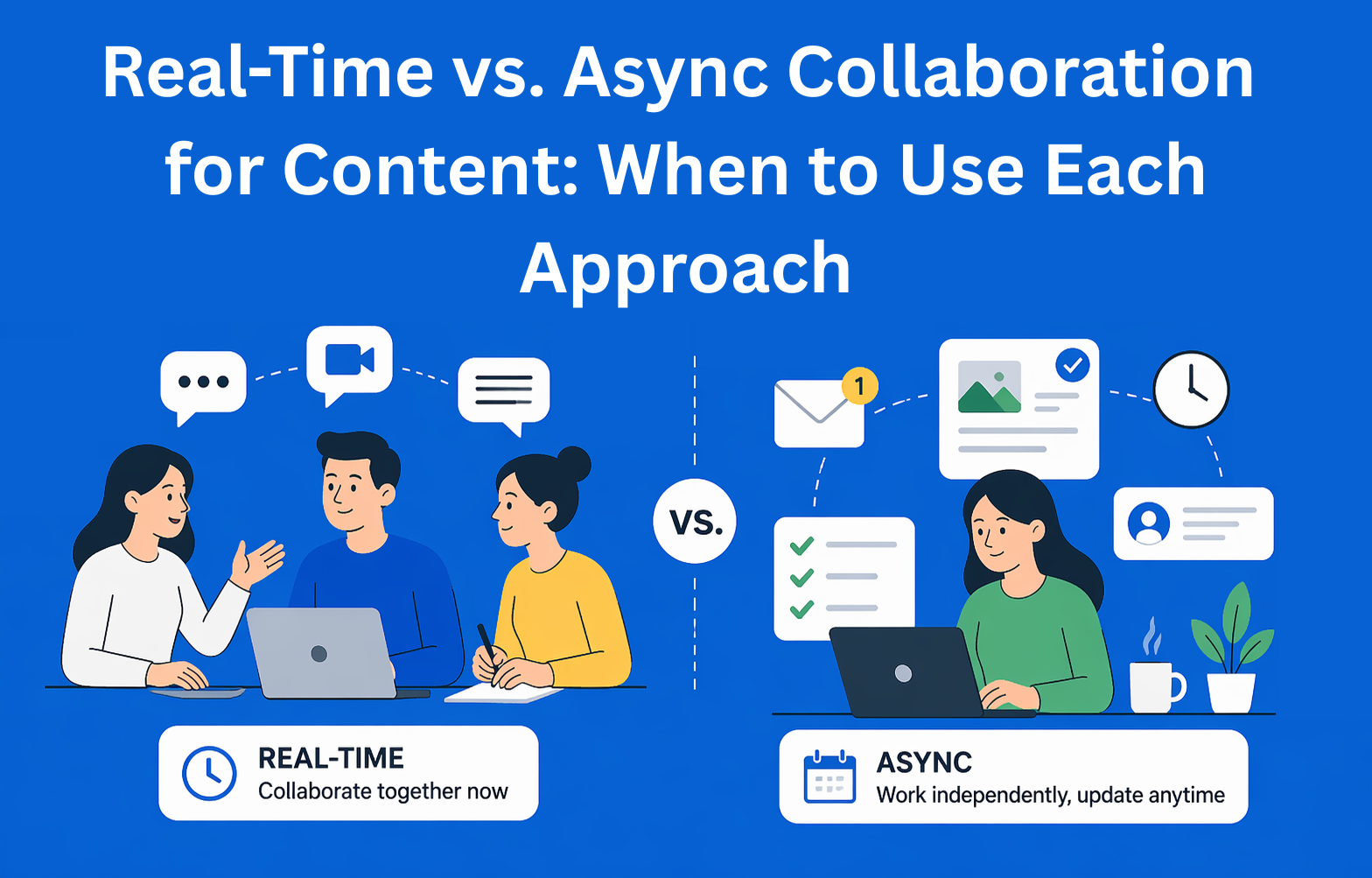
When multiple people work together on content, sooner or later the same question comes up: should everyone work at the same time, or should each person work when it suits them?
This is not just a technical question. How you work affects how fast you finish, how satisfied your team is, and how good the final result is.
In this blog, we will cover both approaches, real-time work and async work, and explain when it makes sense to use each one.
Key Takeaways
- Real-time and async collaboration solve different problems - one optimizes for speed and alignment, the other for focus and flexibility.
- Real-time work is best for fast decisions and complex discussions - brainstorming, urgent issues, and alignment benefit from live interaction.
- Async work enables deep focus and scalable workflows - content creation, reviews, and distributed teams perform better without constant interruptions.
- Hybrid collaboration delivers the best results - combining async preparation, real-time decisions, and async execution improves efficiency.
- Clear rules and tools prevent collaboration chaos - defining when and how each method is used keeps teams productive and aligned.
What does it mean to work “in real time”?
Real-time work, or real-time collaboration, simply means that everyone works at the same time and sees every change as it happens. Like sitting at the same table and writing on the same piece of paper together.
Tools that make this possible include:
- EasyContent, where you can track content changes directly in the editor, access all versions of content, and communicate with team members in real time
- Google Docs, where you can see someone typing while you are reading
- Figma for design, or a simple video call where you talk things through live
This way of working is best when you need to align quickly, make a decision, or solve something urgent.
What does it mean to work “asynchronously”?
Async work means that everyone works in their own time, without needing to be available at the same moment. One team member creates a draft, another reviews it later, leaves a comment, and the process continues without pressure for everyone to be online at the same time.
Tools that support this way of working include Notion, Trello, Asana, email, and even recorded video comments using tools like Loom.
This is especially useful for teams working from different cities or countries, because people don’t have to be online at the same time or wake up at inconvenient hours for meetings.
Pros and cons of each approach
Real-time
Real-time work has one big advantage: speed. When everyone is talking at the same time, decisions are made faster, confusion is cleared immediately, and the whole team feels involved.
When you work together, you have more energy and it is easier to stay focused and motivated because you are not alone.
But there are downsides. The biggest one is that it requires time alignment, everyone has to be available at the same time, which is not always possible. Also, constantly being “online” can interrupt deep, focused work. No one can write properly if messages are coming in every five minutes.
Async
Async work gives people freedom and time to think. When you don’t have to reply immediately, you have time to think and do the work better.
Another big advantage is documentation, everything is written down, and it is easy to track who said what and when.
The downside? It can be slow. If you are waiting for feedback and someone doesn’t check a message for two days, the work stops. Without direct conversation, misunderstandings can happen easily, because you cannot see how something was said from a message.
When to use real-time collaboration
There are situations where real-time work is the best option.
- Brainstorming and project kick-off are a great example. When you are just starting and need to generate ideas, live conversation is much faster than email. Ideas build on each other and in a short time you already have something concrete.
- Urgent situations are another clear case. If a client is unhappy and you need to react quickly, you cannot wait for everyone to read an email. You need to connect immediately and solve the problem.
- Complex discussions where there are multiple options, it is better to talk live than to go back and forth over messages. When you can hear each other and respond immediately, it is easier and faster to reach a decision.
A simple rule: If waiting for a response blocks the team, you should probably talk live.
When to use async collaboration
On the other hand, there are many situations where async works better than meetings.
- Content review and feedback is a classic example. Someone writes a draft, shares it, and everyone reviews it in their own time. People leave comments, and only then align on bigger changes. This gives people space to think instead of reacting under pressure.
- Teams in different time zones often have no other option. It makes no sense to force meetings if it is midnight for someone and midday for someone else. Async is not a compromise here, it is the only practical choice.
- Content production - writing, design, editing, almost always works better with focus and no interruptions. A writer needs hours of uninterrupted time. If they are constantly pulled into quick meetings, they will not finish the work.
Simple rule: If people can keep working without waiting for others, use async.
Hybrid approach - what actually works in practice
In reality, most good teams do not choose only one model. They combine both in a smart way.
A typical setup looks like this:
- Async prep - before a meeting, everyone reads materials, thinks, and prepares ideas
- Real-time session - a short, focused meeting where decisions are made
- Async follow-up - after the meeting, tasks are assigned, comments are added, and work continues in each person’s own time
This way, meetings are shorter and more focused, and everything stays documented.
The right tools at the right time
It is not enough to know when to use each approach, you also need the right tools.
For real-time content collaboration, EasyContent is one of the most practical options. For design, Figma, which you can integrate with EasyContent. For communication, Slack, Teams, or a simple video call.
For async collaboration, Notion and Dropbox Paper are great for writing and commenting at your own pace. Loom is perfect when you want to explain something visually without scheduling a meeting. Asana and Trello help track who is doing what and by when. You can also use EasyContent here, since it supports all of these workflows.
The key is not to use as many tools as possible, but to make sure everyone knows which tool is used for what, and to stick to that.
Conclusion
At the end of the day, there is no single right answer to whether real-time or async work is better. Both have their place, depending on what you are doing, who you are working with, and the situation.
The most successful teams do not choose one over the other, they combine both and adapt based on the situation. That is what makes the difference between a team that is constantly “putting out fires” and a team that actually moves forward.
EasyContent keeps templates consistent across every client project
- Clone a template into another project instead of rebuilding it from scratch
- Custom fields capture the details a generic content tool leaves out
- A sitemap-style hierarchy tree keeps a site build visible at a glance
- Categories and tags stay organized per project, never mixed across clients