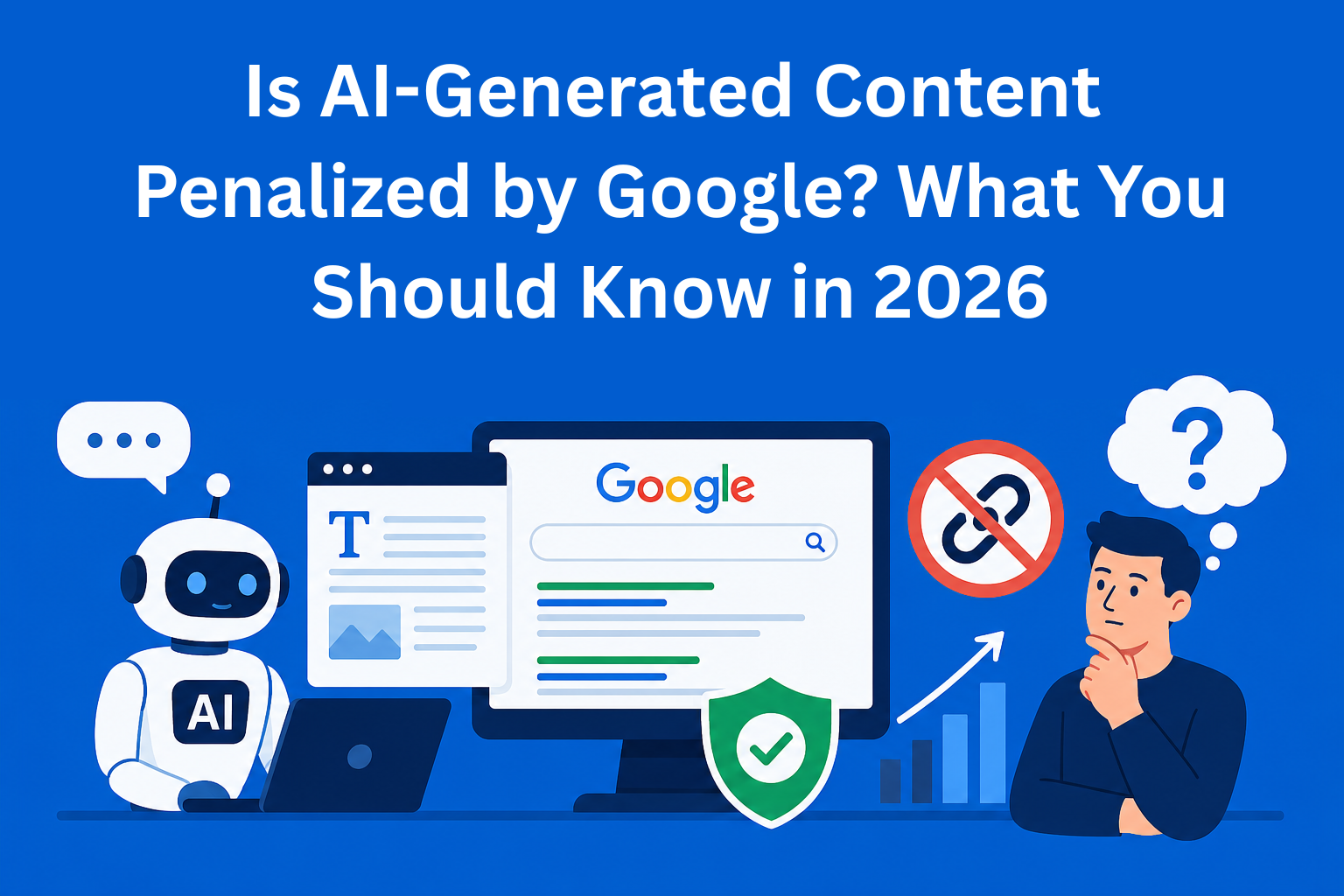
Is AI-Generated Content Penalized by Google? What You Should Know in 2026
Wondering if Google penalizes AI content in 2026? Here’s the truth: Google cares about quality, not who writes it. Learn what matters most for ranking high and how to make AI + human creativity your winning combo.

Anyone who has been creating content for the internet over the last few years has probably asked themselves this question at least once: “Will Google penalize me if I use AI to write content?”
And honestly, it makes sense. AI tools like ChatGPT, Claude, and Gemini are now used almost everywhere. Writers, marketers, and website owners use them because they save time and make work easier. But many people are still afraid that AI-generated content could hurt their Google rankings or reduce traffic to their website.
In this blog, we will clear up whether that is actually true and explain the best way to use AI.
Key Takeaways
- Google does not penalize AI content by default - the problem is not how content is created, but whether it is useful, accurate, and valuable to readers.
- Low-quality and mass-produced content is the real risk - generic, misleading, or keyword-stuffed content gets pushed down regardless of whether AI was used.
- Human input is essential for strong performance - editing, fact-checking, and adding real experience make AI-assisted content trustworthy and effective.
- Originality and expertise matter more than ever - content with real insights, data, and clear authorship performs better in modern search results.
- AI should be used as a tool, not a shortcut - combining AI efficiency with human knowledge leads to better content and sustainable SEO growth.
What Does Google Actually Say About AI Content?
Google has explained multiple times how it views AI-generated content, and the rule is actually very simple:
Google does not penalize content just because it was created with the help of AI. The problem starts when the content is poor, useless, or created only to manipulate Google search results.
That is the key difference. Google does not ask, “Who wrote this?”, Google asks, “Is this useful to the person reading it?”
Their system for evaluating content quality is called the Helpful Content System. This system exists to reward content that genuinely helps readers and to reduce the visibility of content created only for rankings instead of real people.
So, if you use AI to create content that is truly useful, accurate, and well-written, there is no reason to worry.
What Google DID Penalize, and Why
Many people became confused because Google really did penalize some websites that used AI-generated content. But the problem was not AI itself. The problem was the way the content was created.
1. Mass-producing pages with no real value
Imagine websites using AI to publish 10,000 articles in a single month. Those articles were short, generic, and full of useless information. Google pushed those websites down in search results because the content was not helping people. It was created only to attract clicks through keywords.
2. Content that lies or makes things up
AI can make mistakes. It can invent statistics, mention sources that do not exist, or provide incorrect information. If that kind of content gets published without any fact-checking, Google sees it as untrustworthy and pushes the website lower in search results.
3. Articles without a real author or expertise
Google likes to clearly see who wrote the content and whether that person actually understands the topic. That is why articles with a real author, experience, and useful information usually perform better. Content without an author or real expertise often performs worse on Google.
4. Keyword stuffing
This is nothing new, but AI made the problem easier. Some people used AI to overload articles with keywords until the content became unreadable and unnatural. Google has been penalizing this for years, no matter who or what created the content.
What Google Does NOT Penalize
Now for the good news, and there is a lot of it.
AI as an assistant, not a replacement
Today, many people use AI as a writing assistant. AI can create the first version of a text, and then a person reviews it, fixes mistakes, adds personal experience, and improves the content. Google does not consider this a problem if the content is useful and high quality.
Well-edited AI content with original insights
If AI writes a text, but you add your own experience, include real examples, fact-check the information, and make the content genuinely useful to readers, then that is AI-assisted content and there is no reason for it to be penalized.
Websites growing with the help of AI content
Many websites managed to increase their traffic with the help of AI tools. They used AI to research topics more easily and create the first draft of the content, then edited the content themselves and checked the information. This helped them create better content faster while saving time.
What Was Actually Happening in 2024 and 2025?
If you have been following the SEO world over the last few years, you have probably heard about many websites losing traffic. And many people blamed AI-generated content for it. But the truth is a bit different.
The websites that lost rankings all had one common problem, they were not offering anything readers could not already find on thousands of other websites. The content was painfully generic. No original data, no personal experience, and nothing that made it stand out.
On the other hand, the websites that kept growing used AI as a tool, but they still invested in originality, accuracy, and useful content. According to industry data published by Semrush and Search Engine Journal, websites with clearly defined authors and expert-level content continue to perform better even when they use AI during the writing process.
The conclusion is simple: AI was never the real problem. Bad content was.
How to Create AI Content That Google Likes, A Practical Guide
Alright, the theory is clear. Now let’s talk about what you should actually do.
✅ Always review what AI writes
Never publish text directly from ChatGPT or any other AI tool without reading it first. AI can make mistakes, invent information, or repeat the same sentences. You are responsible for what gets published on your website.
✅ Add something only you can provide
Your experience, your story, your opinion. That is what Google values and what separates you from thousands of generic pages. One real example from your own experience is worth more than ten general sentences.
✅ Put a real author on the article
Add a name, a short bio, maybe even a LinkedIn profile link. This shows Google and readers that there is a real person behind the content with actual knowledge and experience.
✅ Link to trustworthy sources
If you make a specific claim, show where the information came from. A link to a study, report, or official source tells Google that you care about accuracy.
✅ Write for readers, not for algorithms
This may sound cliché, but it is extremely important. Before publishing content, ask yourself: “Does this actually answer the reader’s question? Does it help them?” If the answer is not clearly yes, go back and improve it.
✅ Use images, tables, and video
Content with visual elements, useful tables, or videos usually performs better and keeps readers on the page longer. AI can help with the writing part, but you should still add the visual side yourself.
Where Is Google Heading in 2026 and Beyond?
This is the question everyone is asking, and the truth is that nobody can predict every future change with certainty. But there are some very clear trends.
AI Overviews are changing the game
Google has started showing AI-generated answers directly at the top of search results pages. This means traditional organic results are getting fewer clicks for some searches. For writers and website owners, this means one thing: shallow content that only answers simple questions is becoming less valuable. What survives are deep analyses, original data, and experience-based content that AI cannot easily reproduce.
Originality is becoming more valuable
Google increasingly values what people call first-hand content, original research, original data, and original case studies. If you have something nobody else has, that becomes extremely valuable in the SEO world of 2026.
The rules are getting stricter, but not for quality content
Google continues improving its systems for detecting spam and generic content. But for writers who genuinely try to help readers, the rules have not really changed. Quality content has always won.
Conclusion
So, does Google penalize AI-generated content?
No. Google penalizes bad content.
Artificial intelligence is just a tool. Like any tool, everything depends on how you use it. A knife can slice bread or hurt someone, it depends on the person using it, not the knife itself.
If you use AI to find good ideas faster, create drafts, and then improve the content with your own knowledge and experience, Google will not penalize you for that. But if you use AI to create thousands of low-quality pages without any effort or value, that is a completely different story.
The main message for 2026 is the same as always: write for people, not for algorithms. The only difference now is that you have a powerful tool that can help you do it faster.
EasyContent structures every piece of client content the same way
- Templates with custom fields keep every writer working to the same brief
- Recommended word and character counts guide writers on the fields that need them
- Content is organized page by page against the sitemap
- Custom structures let a single item flex when a template does not fit