Content Planning for Small Teams: How to Do More with Less
Struggling with content planning? Learn how small teams can create better content with less effort. Discover simple systems, content pillars, and repurposing strategies to get more traffic, leads, and results without burnout.

If you have a small team or you’re working alone, this probably happens to you: you have a lot of ideas for content, but by the end of the week you realize you did less than you planned. Or you work a lot, but the results are weak, few likes, little traffic, few clients. That’s exactly why content planning exists.
Content planning for small teams is not the same as for big companies with full marketing departments. You don’t have the budget for ten people, and you don’t have time to come up with something new every day. That’s why you need to be smart. The goal is to get more done with less effort, while your content actually brings results.
In this blog, I’ll show you how to build a simple content planning system that won’t exhaust you, but will still work.
Key Takeaways
- Small teams need focused planning, not more effort - without a clear system, content becomes inconsistent and results stay weak.
- Quality beats quantity every time - a few strong pieces that solve real problems outperform frequent low-value content.
- Content pillars bring structure and consistency - focusing on 3-5 core topics prevents scattered ideas and wasted effort.
- Repurposing maximizes output with minimal work - one strong piece of content can be turned into multiple formats across channels.
- Simple systems are easier to maintain - basic calendars, clear roles, and weekly planning routines keep content production sustainable.
Common mistakes small teams make
Most small teams do content planning on the fly. One day you get an idea, you write something, you publish it, and move on. That means you’re working without a plan, just reacting to ideas as they come.
Another big mistake is trying to do everything at once: blog, Instagram, LinkedIn, newsletter, TikTok… In the end, everything gets stretched thin and nothing is done properly.
Many people focus on quantity. They think that if they publish 20 posts a month, things will improve. But it’s better to create 5 high-quality pieces than 20 average ones. Another common issue is the lack of a system. Without a clear calendar and process, tasks get forgotten or everything ends up on you if you’re working solo.
In the end, people burn out. When you don’t have a clear plan, every week feels like a race against time.
Core principles - do more with less
The idea is simple: you don’t need to work more, you need to work smarter.
First rule: as we said, it’s better to create less content, but make it really good. One quality piece that solves a real problem is worth more than ten average ones.
Second: focus on content that brings the best results. That’s the content people share, spend time on, and that makes them reach out or buy.
Third: use repurposing. One good piece of content can be used in multiple ways. That saves you a lot of time.
Finally, the most important thing is to have a system. When you know what to do and how to do it, you keep going even when you don’t feel like it.
How to build an effective content planning system
Start with goals. What do you want to achieve with content planning? More website traffic? More clients? More trust from your audience? Or a bit of everything?
Write down 2-3 clear goals. For example: “I want to get around 30 new inquiries per month through content” or “I want my website to rank in the top three results when people search for advice related to my product.”
Next, understand your audience. You don’t need big research. Read the comments people leave, check what they ask in messages, or run a short survey with 3-4 questions. What are their problems? What do they struggle with? What do they want to learn?
Then come content pillars, your main themes. These are 3 to 5 core topics you’ll build your content around. For example, if you’re in digital marketing, your pillars could be: “How to get more leads,” “How to run successful campaigns,” “SEO tips for better rankings,” and “How to increase online sales.”
Once you have your pillars, all your content ideas can fit into them. This prevents you from jumping from one topic to another.
What kind of content works best for small teams? Evergreen content, content that stays useful even after six months or a year. This includes how-to guides, lists, checklists, templates, case examples, and your personal take on things others are doing differently.
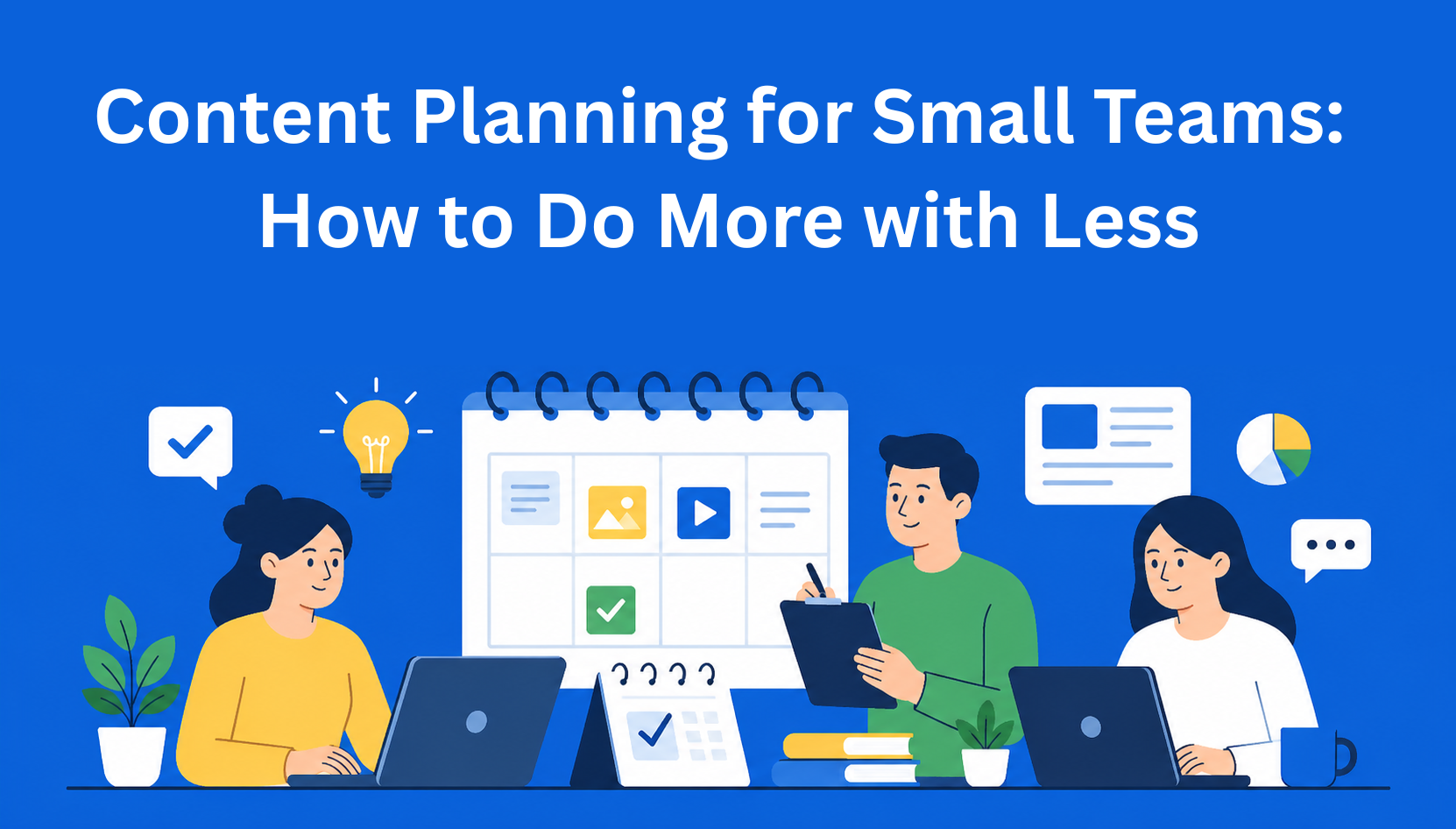
A simple content calendar for small teams
You don’t need a complex calendar with 50 columns. Keep it simple.
Start by planning monthly. Most small teams can realistically create and publish 4 to 8 larger pieces per month, one longer blog post, a few shorter posts, and some visuals or videos.
A good trick is batching your work. Instead of doing a little every day, take one day and write multiple pieces at once. Another day, record all your videos or create visuals.
For example: one main post per week + 2-3 smaller social posts that support it.
You can use a simple Google Sheet or a Notion page. Columns: date, title, topic (which pillar), format (blog, carousel, video…), status (idea, in progress, done, published), and owner.
Content repurposing - your secret weapon
This is probably the most important part for small teams. Instead of starting from scratch every time, take one good piece of content and use it in multiple ways.
For example, you write a longer blog post. From it, you can create:
- A LinkedIn or X thread
- A carousel with key points
- Short video clips (30-60 seconds)
- Parts for a newsletter
- An infographic
- Quote visuals for Instagram
One day of work can give you content for the next two to three weeks. That’s why many small businesses use this approach, it saves a lot of time. One good piece can easily turn into 10-15 different posts.
Start repurposing by creating one main piece (usually a blog or long-form video), then break it down into smaller pieces.
Tools that save you time
You don’t need expensive tools. Here’s what most small teams use successfully:
- Notion or Google Sheets for your content calendar
- ChatGPT or Claude for ideas, outlines, and first drafts
- Canva for visuals and carousels
- CapCut or Descript for simple video editing
- Buffer, Metricool, or similar tools for scheduling posts
With these tools, you can handle 80% of the work without spending your whole day.
Another tool that can significantly simplify content planning and production is EasyContent, where you can:
- Build your own workflow and track content status,
- Assign roles to each team member,
- Plan content using a built-in calendar,
- Create customizable templates for any type of content,
- Collaborate and communicate in real time
And these are just some of the available features.
Who does what in a small team
If you have a team of two to four people, clearly define roles. One person can handle ideas and planning, another writing, and a third visuals and scheduling.
If you’re working alone, use a simple weekly ritual. Set aside one hour each week to review the next 14 days. What needs to be done? What can be repurposed?
It’s important not to aim for perfection. It’s better to publish something good on time than to wait a month for something perfect.
What to track and how to know it works
You don’t need to track everything. For small teams, 3-4 metrics are enough:
- How many people come to your site from content
- How much time they spend reading or watching
- How much engagement you get (comments, messages, shares)
- How many leads or sales come directly from content
Look at results monthly, not daily. If you see that one pillar brings more traffic or messages, focus more on that.
Conclusion
The point is simple: you don’t need to work more hours, you need to work smarter. Set clear goals, stick to a few core topics, and reuse your content in multiple ways. When you have a system, you worry less and focus on what really matters.
If you’ve been working without a plan, next week do this:
- Write down 3 main content goals.
- Define your 3-4 content pillars.
- Create a simple 30-day content calendar.
Start with that and you’ll quickly see progress. You don’t need a big team to create great content, you just need a good system and a bit of discipline.
If you apply this, you’ll notice you’re doing less, but getting better results.
EasyContent lets AI draft content without removing the human sign-off step
- AI permission controls sit at the account, project, and user level
- Style guide enforcement applies to AI output the same way it applies to a person's
- Every AI suggestion goes through the same review stage as a human draft
- A version history records who approved each AI-touched change