Patient Education Content: How to Create, Review, and Manage at Scale
Learn how to create clear, simple patient education content at scale. Discover how to write, review, and manage healthcare materials so patients understand their care, follow treatment, and reduce repeat hospital visits.

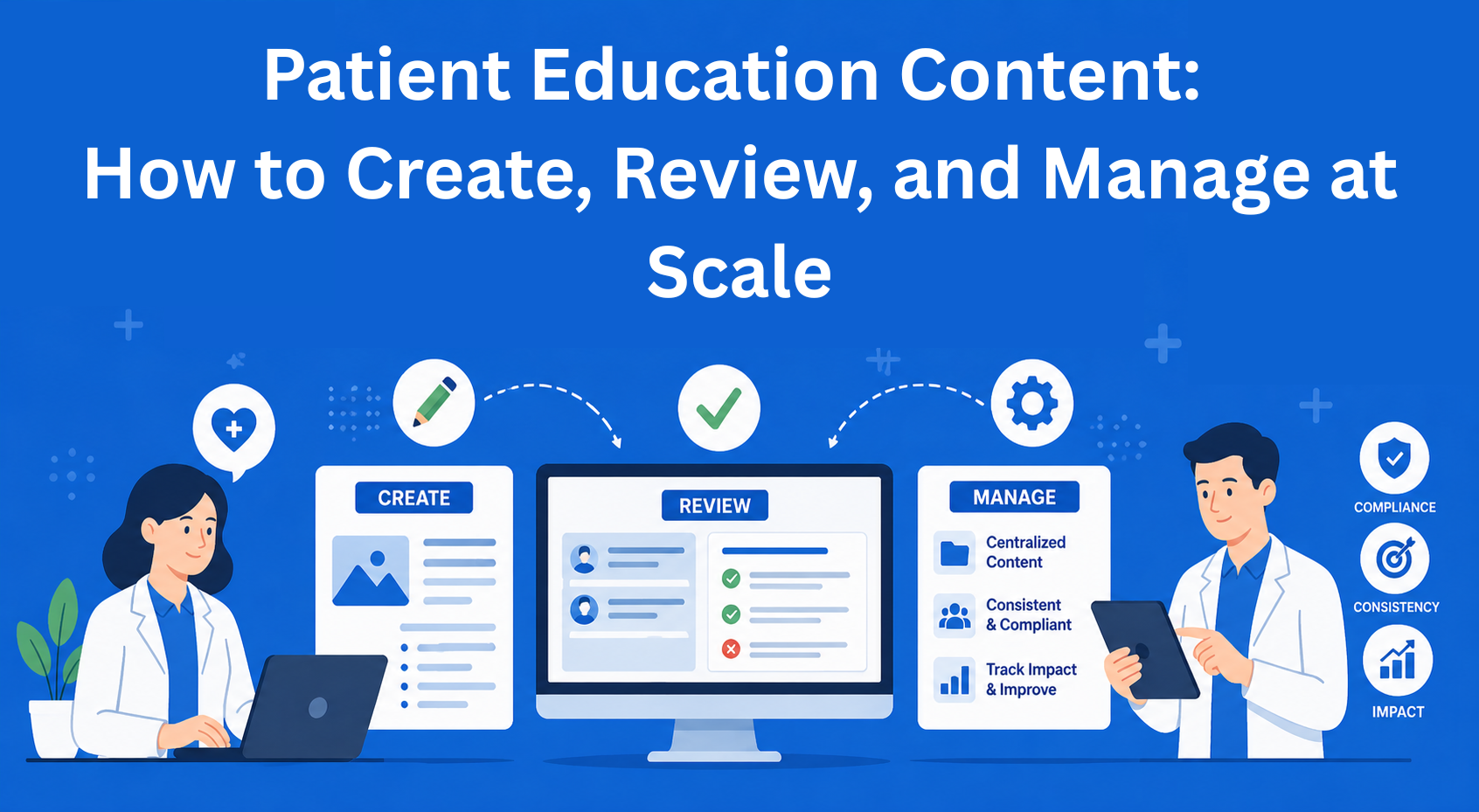
All of us have been patients at some point or will be in the future. When we get a diagnosis or go in for surgery, we want to know what is happening to us, what we need to do, and how to take care of ourselves at home. That’s why patient education materials matter - these are simple texts, images, videos, and instructions that clearly explain health information to people.
Today, large hospitals and clinics create a lot of these materials. This means creating and managing educational content for a large number of patients. If this is done poorly, people get confused, don’t follow doctors’ advice, and end up back in the hospital more often. If it’s done well, patients understand what to do, take their therapy more regularly, and problems happen less often.
In this blog, we will see how to create this kind of content from the start, how to review it so it is accurate and clear, and how to manage it when you have a lot of it.
Key Takeaways
- Patient education content must be clear and easy to understand - simple language and visuals help patients follow instructions and improve outcomes.
- Accuracy and review processes are critical in healthcare content - medical, legal, and accessibility checks ensure content is safe and reliable.
- Scaling requires structured systems and workflows - clear processes for creation, review, and updates prevent confusion and outdated information.
- Collaboration between teams improves content quality - doctors, writers, and editors must work together to balance clarity and accuracy.
- Continuous updates keep content relevant and effective - regular reviews ensure materials stay accurate as medical knowledge evolves.
Why is this important?
Imagine you were given medicine that you need to take three times a day. If you don’t understand why and how, it’s easy to skip a dose or stop too early. Because of that, the illness can get worse and lead to another visit to the doctor.
Good patient education content helps patients understand what is happening to them. This leads to better cooperation with doctors, fewer repeat hospital visits, and higher satisfaction. Hospitals that provide clear instructions often get better patient ratings. And that also affects how much money they receive from insurance.
There is also a legal obligation. A patient must understand what is being done and why. That’s why the text needs to be written simply, so anyone can understand it - even someone with little knowledge or someone who is not familiar with medical terms.
How to create patient materials at scale
The first step is not writing. The first step is thinking about who you are writing for.
Create patient profiles. Think about who your patients are: are they older people, young parents, people with chronic conditions like diabetes or high blood pressure? How old are they, how well do they read, what language do they speak? When you know your audience, writing becomes easier.
Then make a list of topics. What do you need to cover? Explanations of conditions, preparation for surgery, how to take medications, what to eat, when to contact a doctor… Make a table of topics so you don’t repeat yourself and don’t miss anything.
Write in simple language. Avoid complex medical terms or explain them right away. Instead of “hypertension,” say “high blood pressure.” Instead of “procedure,” say “checkup or surgery.” Aim for the text to feel like you are talking to someone in everyday life.
Use short sentences. One idea per sentence. Add images, infographics, or short videos because many people understand better when they see something, not just read it.
Today, artificial intelligence can help with the first draft. But it always needs to be checked by a doctor or medical expert, because accuracy is the most important thing.
There are tools like PEMAT (Patient Education Materials Assessment Tool) that help you evaluate whether the material is clear and whether a patient can actually apply the advice in practice.
How to review and approve content
When you write a text, it must go through a review process.
The main problem in large organizations is that many people are involved: doctors, nurses, legal teams, compliance teams, and marketing. This can take weeks or even months. Meanwhile, the patient is waiting.
To speed things up, create a clear review process:
- Check medical accuracy (is everything correct and up to date).
- Check clarity of language (is it understandable to a regular person).
- Check legal and safety requirements.
- Check accessibility (can people with low vision read it, is the contrast good enough).
- Check if it matches the hospital or company style.
Create a RACI table - who is responsible, who approves, and who is only consulted. This reduces confusion and repetition.
Use tools like EasyContent, where everyone can comment in one place, track content versions, and follow content status through a clear dashboard. This can reduce the time from writing to final material from a month to just one week.
How to manage materials when you have a lot of them
If you create a lot of materials every month, you need a good system. You can’t keep everything in folders on your computer because you will quickly get lost.
Simply put, every piece of content goes through several steps:
- Creation
- Review and approval
- Publishing
- Sharing with patients
- Tracking whether it is used
- Updating or archiving when information becomes outdated
Medicine is constantly changing. What was true a few years ago may not be true today. That’s why it’s important to regularly review and update your materials.
For this, you need content management systems (CMS). The best ones for healthcare allow:
- Version tracking (so you can see what changed)
- Automatic reminders when updates are needed
- Access control (who can edit what)
- Easy publishing in multiple places: hospital websites, mobile apps, email, or QR codes in waiting rooms.
One example of such a tool is EasyContent.
How to do all of this at scale
To create and maintain hundreds or thousands of materials per year, you need:
- A team that works together - writers, doctors, and editors.
- Simple rules for how each text should be written.
- Tool support where possible - for example, to create a first draft or send content for review.
- Tracking whether people read the content to the end and whether they understand what to do.
It’s important to track: whether patients take their medication regularly, whether they return to the hospital less often, and whether they are satisfied with the information they received.
The most common mistakes are:
- Using too many complex words.
- Keeping outdated information that is no longer correct.
- Creating materials that look nice but are not understood.
- Poor collaboration between doctors and marketing teams.
- Forgetting to ask patients what they need and what is not clear to them.
Conclusion
If you want to improve patient education in your hospital or team, start with small steps.
Start by making a list of the topics patients ask about most often. Then write a few texts using simple language and check if people actually understand them. Introduce a clear review process and use a tool that helps you keep everything organized.
Patient education is not just marketing. It is a way to help people when they need it most. When people understand what is happening and what they need to do, everyone benefits - patients, doctors, and the entire system.
Start with clear, simple, and accurate information. The results will come faster than you think.
EasyContent's pricing doesn't punish agencies for winning new clients
- No per-seat pricing on Team and above, so costs stay predictable
- Published prices from $47 a month billed annually, or $59 monthly, with no sales call needed to see them
- External stakeholders review and approve without ever taking a seat
- Try it free for 14 days, no card on file